
IMPC News

IMPC starts data delivery for PECASUS
IMPC provides Scintillation and TEC data to PECASUS consortium which is the one of the three global centers providing space weather advisories according to ICAO regulations.
For more information pecasus.eu

International Workshop on GNSS Ionosphere (IWGI2019) - Theory, Algorithms, Modelling and Applications
September 23-25, 2019,
German Aerospace Center (DLR), Neustrelitz, Germany

1st TechTIDE User Workshop
May 15, 2019,
German Aerospace Center (DLR), Neustrelitz, Germany
New release of the IMPC webportal
Today, we introduce a new release of the IMPC webportal with many new features. This shows, the transition from the prototype webportal of the Space Weather Application Center - Ionosphere (SWACI) is progressing.
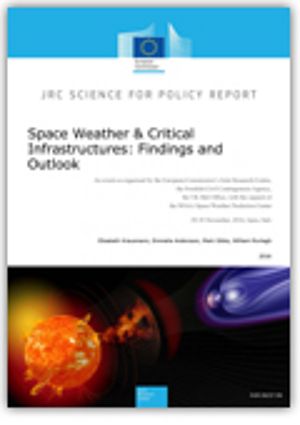
Space-weather risk reduction efforts in the EU and remaining gaps
European Commission's Joint Research Centre (JRC) published the new report “Space Weather & Critical Infrastructures: Findings and Outlook“. Here, they underline the absolute necessity to protect critical infrastructure through coordinated collaboration by national activities.
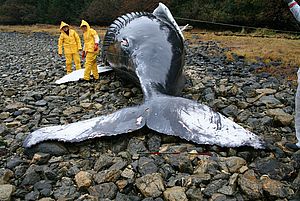
NASA Scientist Studies Whether Solar Storms Cause Animal Beachings
NASA reports about the force behind one of nature's strangest mysteries.

Presentation of IMPC and Ionosphere Expert Service Centre at the European Space Weather Week
The IMPC-team attended the 13th European Space Weather Week, which took place November 14-18, 2016 in Oostende (Belgium). At this conference, we were not only present to demostrate the status of IMPC but also in the role of the coordinator of the Expert Service Centre Ionospheric Weather (I-ESC) in the <link http: swe.ssa.esa.int external-link-new-window internal link in current>ESA Space Weather network.
Space Weather Events
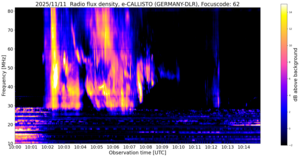
Further solar eruptions – possible disruption to satellite navigation
Several solar flares and coronal mass ejections (CMEs) occurred between November 9 and 11. The strongest flare is reported to have had a magnitude of X5.1, with the geomagnetic storm on Earth reaching category G4 (“severe”).
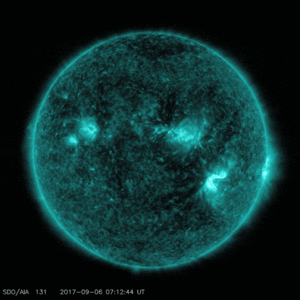
Severe solar flare event on 06.09.2017
On September 6th around 12 UT, sunspot AR2673 unleashed a major X9.3-class solar flare - the strongest solar flare in more than a decade, cf. image below. Although this flare was very powerful and accompanied by a CME it is relatively mild when comparing it with extreme events like the "Halloween Storm Event" (2003) or "Carrington Event" (1859). The arrival of the CME is expected two or three days…
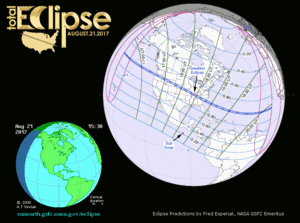
Ionospheric Response to the Solar Eclipse on 21 August 2017
Solar eclipses are always fascinating events for all people having the opportunity to experience it directly. For atmospheric scientists solar eclipses are huge active experiments for studying the response of the Earth’s neutral atmosphere and ionosphere on the well-defined turn off and on of the solar illumination. This will be also the case for the solar eclipse over North America on 21 August…